I've been an EFL (English as a Foreign Language) teacher in Asia since 1996. I did 3 years in a Korean Hagwan from 1996-99. I survived the IMF era of 1997 in Korea. It was a major learning experience for me. Once which I hope no one has to go through.
I came to Japan in 1999 and began teaching in Ichinoseki, Iwate at an Eikawa. I learned two basic things.
1) I enjoy teaching children
2) I don't enjoy business English lessons.
I then moved down to Narita, Chiba. I learned some more things
1) I hate cockroaches
2) Never work in a school located next to a pub.
I then moved over to Yachiyo, Chiba. I learned even more things
1) I really need to work with people who know and enjoy what they are doing
2) There can be alot of paperwork
I then met my wife, went back to Canada, got married, then came back to Japan.
I then took a job in Toyama, Toyama
My next learning experience taught me other things
1) Make sure the company you take a job with is well established and can pay you.
2) Country areas of Japan are very different from the Tokyo area.
3)I still enjoy teaching children.
I began my career as an ALT Assistant Language Teacher
An ALTs job is to assist teaching English in Japanese Elementary and junior high schools. This runs the gammet of either being a live action audio player, or teaching on you own.
More to follow
Thursday, 26 January 2012

Monday, 23 January 2012
The Great Swamp fight King Philip's War 1675
 The Amerindian camp
 New England pike and shot block
 Other New England troops say hidden in the woods
 Some of Church's men and some sword and buckler men
 More New Englanders with muskets, swords
 The pikemen charge in
 Pikemen begin to break into the fort
 The Amerindians await the onslaught
 The chief watches for the whiteman's attack.
 Church's men begin to snipe at the defenders.
 Others begin to move up.
 The pikemen break into the fort.
 A final volley from the New Englanders.
 New England Colonial militia vs Narragansett
2 battalions of militia 3 bands of warriors/civilians
Board: Amerindian fortified village attacked and destroyed
Most of this conflict consisted of attacks on English colonial settlements and counter raids on Amerindian villages. Church’s Rangers were developed in this period.
The re fight 1/8/12
The Narragansett were settled into their village for the winter when Benjamin Church came to pay a visit. The Amerindians, believing they were safe inside their fortified camp in the middle of a frozen swamp never thought the New Englanders were come to make war on them. After all, they had not started the fighting, the other native groups in the area did.
The Amerindian leader, deployed his warriors with muskets outside to try and delay the New Englander advance. The New Englanders on the other hand decided to use Pike and shot tactics to try and smash into the fort. Church's company deployed on the right while the less able militia with muskets took the left. A further collum was behind them armed with older matchlocks and swords and shields. The first Amerindian volley took out some of Church's men but they were slowly shot down by English musket fire.
As the pike block smashed into the fort, the remaining Amerindians fled into the woods during a cold bleak season.
Sunday, 22 January 2012
Historical fiction that gets it wrong!
When I tuck into a historical fiction novel, one written in the time period I enjoy (1690-1815) nothing bugs me more than an author who just didn't put that little extra bit of research into making sure he/she has gotten the terms right.
For example, I'm reading Phantom Ships, an English translation of a French-Canadian novel set in the Seven Years War in Atlantic Canada. Every time the dialogue mentions "rifles" I want to through the book out the window. French Canadians, and the majority of British and Colonial American soldiers used MUSKETS up until about 1840.
Now, it may be that the translator got it wrong, but then again, the author may have used the French word for rifle and the translator just copied it into the English version.
It's like when I read Bernard Cromwell's "Redcoat" novel. It went along great until he mentions the British army marching into Philadelphia wearing "Shakos"!
British soldiers according to the 1768 clothing pattern wore Tricorns if Battalion/Hat companies or Bearskin Grenadier caps if Grenadier companies. Then you had the Light Infantry companies who wore a short cap while Highland Regiments wore bonnets.
It's the little details that really can through off a readers image of a good book.
For example, I'm reading Phantom Ships, an English translation of a French-Canadian novel set in the Seven Years War in Atlantic Canada. Every time the dialogue mentions "rifles" I want to through the book out the window. French Canadians, and the majority of British and Colonial American soldiers used MUSKETS up until about 1840.
Now, it may be that the translator got it wrong, but then again, the author may have used the French word for rifle and the translator just copied it into the English version.
It's like when I read Bernard Cromwell's "Redcoat" novel. It went along great until he mentions the British army marching into Philadelphia wearing "Shakos"!
British soldiers according to the 1768 clothing pattern wore Tricorns if Battalion/Hat companies or Bearskin Grenadier caps if Grenadier companies. Then you had the Light Infantry companies who wore a short cap while Highland Regiments wore bonnets.
It's the little details that really can through off a readers image of a good book.
Thursday, 12 January 2012
Seriously, I gotta ask
Being an ALT (Assistant Language Teacher) in Japan can be really interesting sometimes.
One of the more interesting aspects of my job is to follow along what the Japanese teachers are required to use to teach English in schools.
Their textbook which is called Sunshine has songs for cloze exercises, or to give their students a chance to hear English being used for real.
However, what I take issue with is the use of Carpenters songs. Now, don't get me wrong,the Carpenters were a good group with some nice hits in say the 1970's but I mean, why do we need to subject Japanese teenagers songs that were popular when their parents were in elementary school?
When I have asked Japanese teachers about this, they give the answer that the melodies are nice, the lyrics are easy to understand. Yeah, 1970's easy listening. I mean every time I have to hear Mr. Postman (which I heard about 16 times today) or Top of the World, it takes me back to when to 1977 when I was 4 listening to this stuff on 8track 8 TRACK!!!!!!!!!!!!!!!!!!!!! When the Carpenters were a hot act, I lived in Nova Scotia with a 40inch floor TV which was so big, it doubled as a display table, my parents drove the original Volkswagen Bettles (they had a blue and yellow one)
The TV had 2 channels, the internet was a military secret, cellphones were the same size as military radio sets, computers were large, and the Soviet Union was still a superpower.
One of the more interesting aspects of my job is to follow along what the Japanese teachers are required to use to teach English in schools.
Their textbook which is called Sunshine has songs for cloze exercises, or to give their students a chance to hear English being used for real.
However, what I take issue with is the use of Carpenters songs. Now, don't get me wrong,the Carpenters were a good group with some nice hits in say the 1970's but I mean, why do we need to subject Japanese teenagers songs that were popular when their parents were in elementary school?
When I have asked Japanese teachers about this, they give the answer that the melodies are nice, the lyrics are easy to understand. Yeah, 1970's easy listening. I mean every time I have to hear Mr. Postman (which I heard about 16 times today) or Top of the World, it takes me back to when to 1977 when I was 4 listening to this stuff on 8track 8 TRACK!!!!!!!!!!!!!!!!!!!!! When the Carpenters were a hot act, I lived in Nova Scotia with a 40inch floor TV which was so big, it doubled as a display table, my parents drove the original Volkswagen Bettles (they had a blue and yellow one)
The TV had 2 channels, the internet was a military secret, cellphones were the same size as military radio sets, computers were large, and the Soviet Union was still a superpower.
Saturday, 7 January 2012
My chariot of fire
 My bicycle is a 6 speed touring bike. It's pretty tough. I got hit by a construction truck once. The only damage was a bent basket and some scratches.
The other bicycles are my old orange one with a flat tire and busted brake line, and the Japanese Mammachari (Mothers bicycle for taking babies.)
Helmet and head lamp
 This is the helmet and head lamp which I use in my cycling. The lamp has two settings, white or red. The bulbs are LED powered by 3 AAA batteries.
Cycling to work
Since May 2011, I have decided to cycle to work. There are many reasons for this.
The first could be that I want to loose weight.
Other reasons could be: lessening my carbon blueprint on the earth.
not getting stuck on a train when they are delayed to too much wind
having a reliable mode of transport in this time of earthquake aftershocks.
It's only 16-18km from my home to my schools. So doing that twice a day works out to about 32-36km per day working out so far that since last May, I have cycled over 1000km, replaced one bicycle and invested in a bicycle helmet and a head lamp.
I've lost about 8kg over this time. Though since I have been off for 2 weeks for Christmas/New Years vacation, I've probably put some back on.
The first could be that I want to loose weight.
Other reasons could be: lessening my carbon blueprint on the earth.
not getting stuck on a train when they are delayed to too much wind
having a reliable mode of transport in this time of earthquake aftershocks.
It's only 16-18km from my home to my schools. So doing that twice a day works out to about 32-36km per day working out so far that since last May, I have cycled over 1000km, replaced one bicycle and invested in a bicycle helmet and a head lamp.
I've lost about 8kg over this time. Though since I have been off for 2 weeks for Christmas/New Years vacation, I've probably put some back on.
Wednesday, 4 January 2012
Camping in Japan Part 2
 This had been our camping trip in the summer of 2010. We stayed near a beach with our two tents. One was for sleeping, the other was a dining tent.
  This was our cabin in August 2011. This one had a/c and a fridge!
 In May, 2011 we rented a cabin at a different camp ground. We made our meals on a gas stove.
 My little girl Leena enjoyed blowing off the blossoms from the dandelions while Ian was running around with his musket.
 The cabin was unfurnished so all we needed to do was put down our sleeping bags. The cabin was wired, and had an air conditioner! Talk about roughing it!
 My wife Emi and our daughter enjoying a cool drink in the Tokyo German Village.
 My attempts at archery. I shoot better with firearms. My trousers are Canadian Forces Combat pants issued from 1968-2003. My bush hat and t-shirt are Eddie Bauer items, the only clothing store in Japan which sells larg sizes for Western people.
 Ian on a cool swing. He was on this for about forty minutes.
 Leena prefers a more sedate ride such as this swing.
It's a cold day in Japan but spring will come soon
One of my other hobbies here in Japan is to go camping with my family. Camping in Japan is probobly the cheapest way to spend a holiday once you have all the gear to do so. My wife had gone camping in her first marriage and was nearly put off the experience until she met me. I was able to take our family camping which we all enjoyed. My 3 older step children were convinced that to get a bbq going they needed to get 5 grasshoppers or insects each. After they ran off to do this, my wife asked me why I had done that. I explained that if they were out doing that they would a) be busy doing something fun, b) would burn off their energy c) allow me to get the fire going without having little kids bump into me as I was using fire. d) allowed us to start cooking. After about 40 minutes they came back and apologised that they had found none, but behold, the fire was going.
 Baked potatoes
 Grilled corn (almost too much)
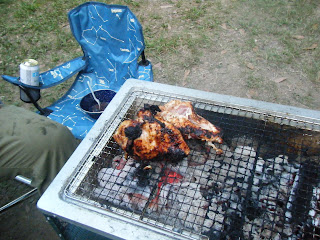 BBQ Chicken
 My son and our friend from Austria. It had been his first time camping in Japan and in about 5 years with a family.When my wife and little ones decided to go camping again, this was what we experienced.
 Baked potatoes
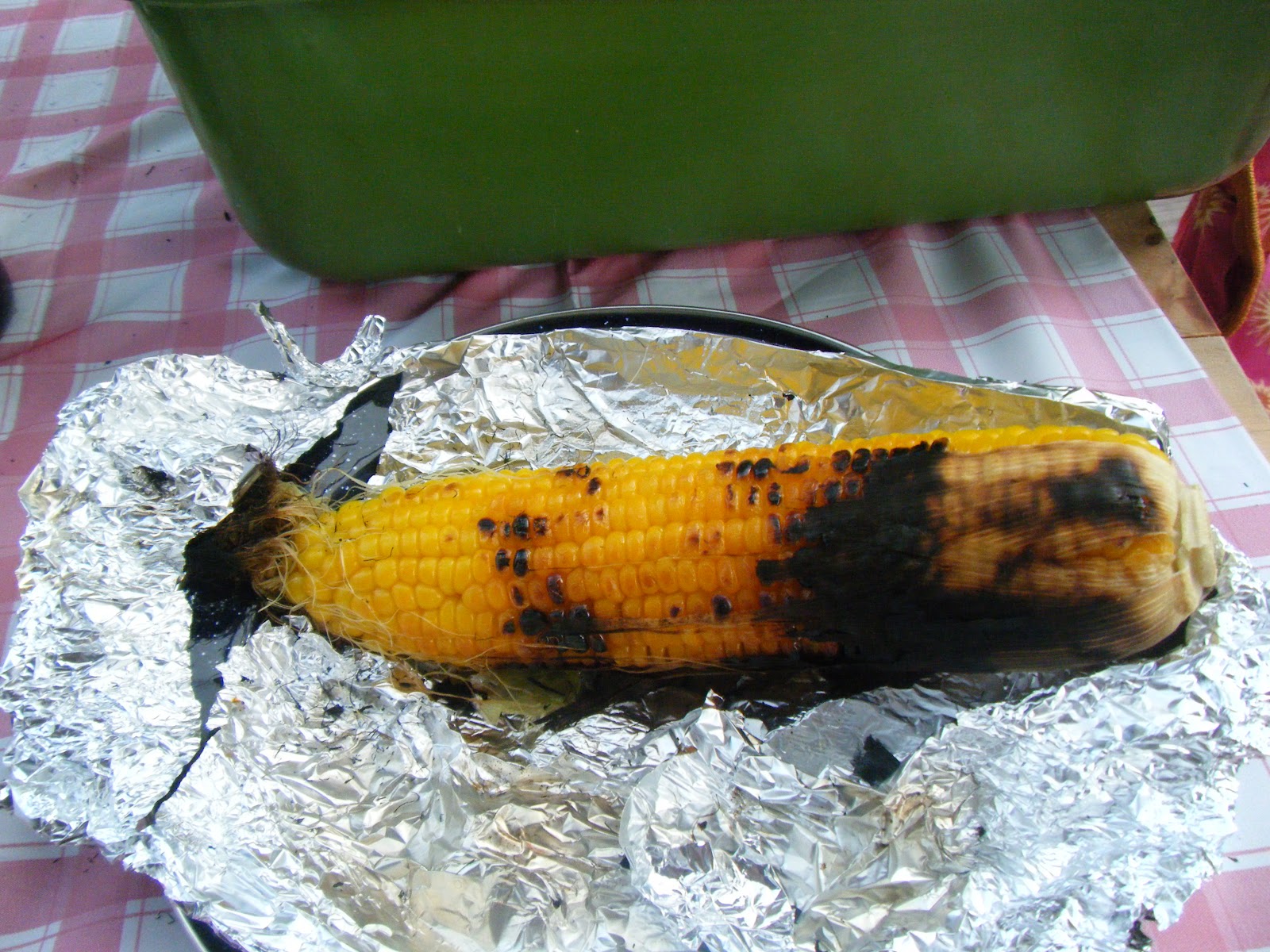 Grilled corn (almost too much)
 BBQ Chicken
 My son and our friend from Austria. It had been his first time camping in Japan and in about 5 years with a family.
Bunker Hill Part 3
 The British centre (shown on the bottom right of this shot) are 1768 pattern Grenadiers assaulting the American entrenchments. On the far left, are the British Light Infantry companies. The American rifles can be seen on the left of the shot. The American commander in this section forgot to give the rifles the order to fire. Having forgotten that rifles can fire further, he deployed his units thinking the British would advance halt and fire. The British turn turned up a 3 card meaning they could complete 3 actions in this turn. Usually when my son and I play a game, this card is the one where we use to destroy our opponent. The British Lights opened fire on the American rifles, destroying them, while the Grenadiers also gave fire. The American militia had no chance to return fire as the entire British line then charged with the bayonet. The American centre and right were whipped out leaving only a small detachment on their left.
British speed and musketry won out on this replay.
Subscribe to:
Posts (Atom)