 Take if from the Japanese to really do a doozy on using English incorrectly. How the hell can something be hot and mild!? I mean Jalapeno and cheese
Sunday, 31 August 2014
Say what? Hot and Mild?!
Take if from the Japanese to really do a doozy on using English incorrectly. How the hell can something be hot and mild!? I mean Jalapeno and cheese
Thursday, 28 August 2014
A chatty kitty and a big solar panel
 This kitty looks like two I had as a child back in Nova Scotia. Both I had named Charlie. Charlie 1 was born sometime about 1978 and lasted until about 1983. Charlie 2 I remember about 1983 to 1994. Pretty old for a cat.
 Due to the energy shortage by the nuclear plant meltdowns up in Northern Japan which produced 40% of the Tokyo regions power, this solar panel was built near where I live. Not sure how many of these will be built in the near future.
Sunday, 24 August 2014
Arakawa camp Kiyosato Yamanashi 2014

This town used to be really hopping. Unfortunately, several combinations have caused many of the shops around the station area to close. A drop in the population, its actually cheaper to travel outside Japan then inside! Its sad, as I counted about 12 shops which were closed, all of which were within walking distance of this station.


Once again, my company was asked by Arakawa Board of Education to teach their World School Program. This year we had teachers from USA, Canada, UK, The Philippines, Australia and New Zealand

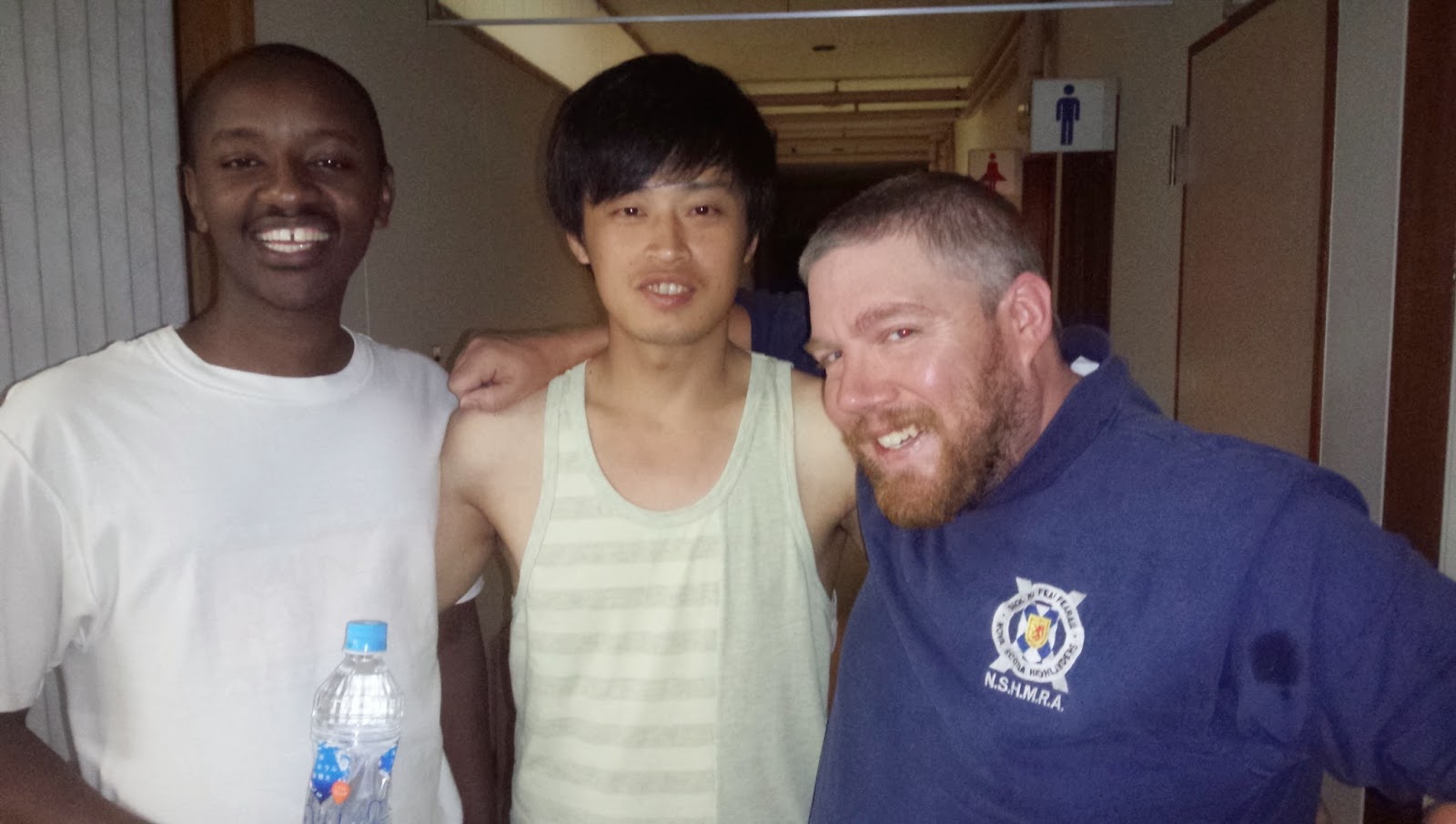

We went up to Kiyosato, Yamanashi from August 21-25. I got home, went to bed for about 5 hours then cycled to school in Edogawa. Unfortunately, I lost my voice from all the excitement we had to do with the students on the trip. I'm still resting it. Hopefully, I will be able to teach my students with some more speaking, but then again, having them do most of the talking means I cut most of my work! I guess its a win win, unless they don't do any talking.
Friday, 15 August 2014
Battle of Wannepang, Nova Scotia 1722
 This action was part of Father Rale's War, one of the frontier actions on the New England, Nova Scotia/Acadia borders. In this instance, a group of MikMaq warriors seized New England fishing vessels. The British governor in Annapolis Royal sent out a government armed vessel to try and defeat them.
 Two vessels, a Royal Navy light vessel under the command of a midshipman on the left and an armed merchant vessel


Thursday, 14 August 2014
American Loyalist troops 1775-84

Left to right:
American Legion, Queens Rangers Hussars company. Royal Newfoundland Regiment, Kings Royal Regiment of New York, Queens Rangers Highland Company.
Green was the color of choice for Loyalist provincial forces as they could blend well into the woods. The cavalry forces made up for the lack of trained horse troops from Britain.
Hessian troops in North America 1775-83
 Depictions of mercenary troops hired by the British government to fight in North America from 1775-83. I shall be updating this posting over the next month as I find my historical information.
British Light Infantry 1768-88
 Several light infantry companies.
As part of the British Army's retraining from 1768, Light Infantry companies were made a part of each battalion in the British Army. Their uniform coats were cut shorter, their caps were designed specifically for their work in the forests, they were issued with tomahawks, rather than small swords, and they were usually the better soldiers in each regiment. They were the first units to engage the American rebels in April 1775.
Battalion companies, British Army 1768-88

The British army, known usually as Redcoats, were the backbone of each Regiment. Each soldier needed to be five feet in height, have all of his limbs, not troubled by fits, have two teeth that met in order to bite open his cartridges.
Far from being the thugs, criminals and dregs of society, many of these men served with pride and distinction, despite being far from home, hated by the American public, and also loathed by their own country.
Wolfes Army 1755-65
 All of my troops painted as the regular British Army which was sent to North America between 1755-65
British commanders in North America 1756-65
 Amherst and Wolfe with two companies of Grenadiers, 22nd and 48th. Amherst is holding the spontoon while Wolfe is holding his walking stick.
Subscribe to:
Posts (Atom)