Saturday, 31 January 2015

Ian's Toy soldiers attack

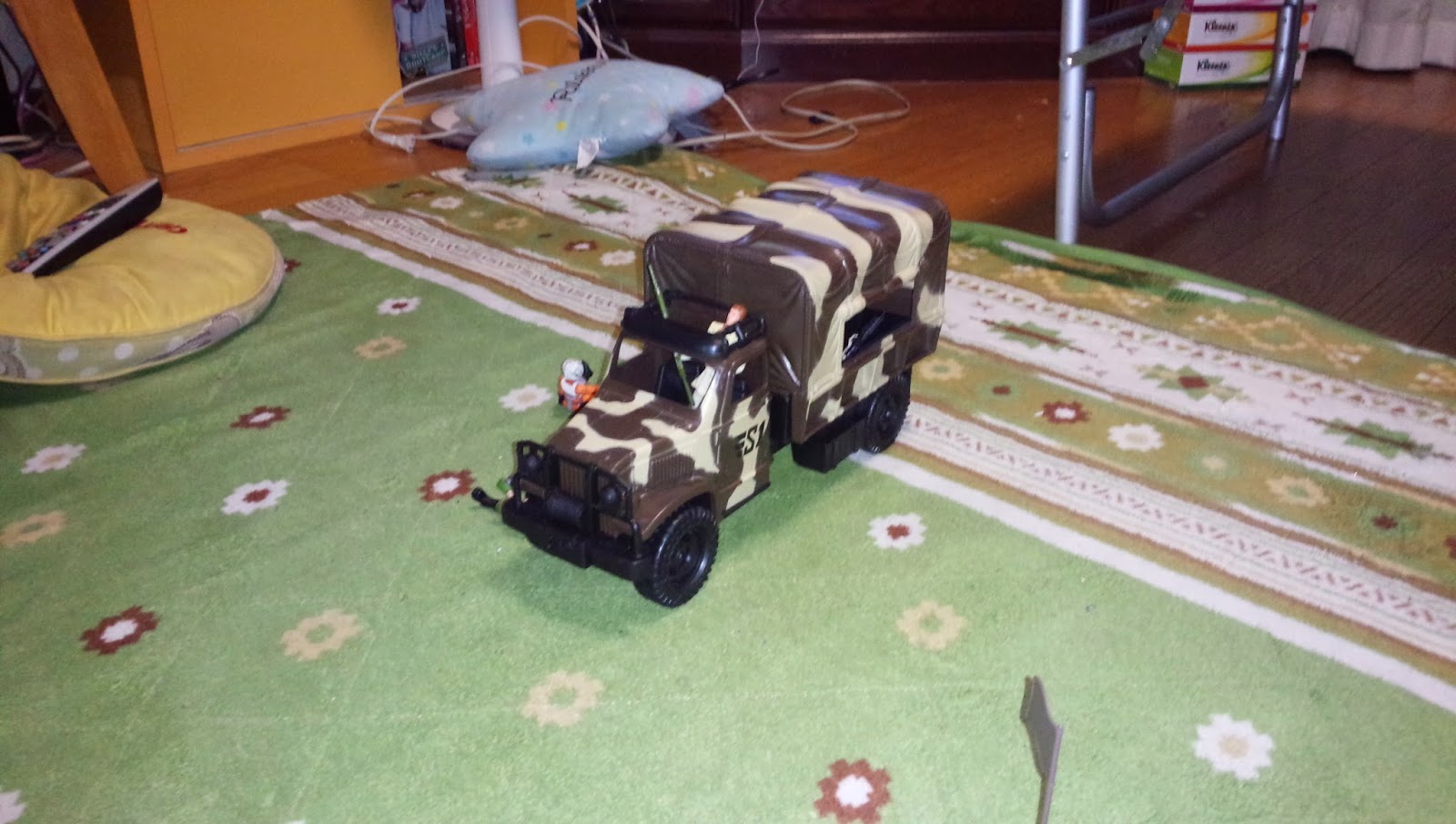
After three years, my wife let Ian get a set of these figures which are a Toys R Us series, similiar to GI Joe. Tonight, we set up a little game to play.

We had his Star Wars figures hold a ruined house and each side needed to capture a specific amount of supplies

 His Star Wars figures and snipers take the ruins out.

Chinese lunch with the kids at Gyoza No Oh Sho

 It's sooo good, 

 Japanese/Chinese fried chicken

 What's a Chinese lunch without fried rice?

Can I eat it all? Daddy, is this the kids size?

 It's right some good!
I took the kids to a Japanese Chinese food chain restaurant called Gyoza No Oh Sho. It's famous for making really tasty Gyoza, or fried meat dumplings, and fried rice. I showed the kids the menu, and showed them the kids section, but they saw the ramen set on the front, which had pictures and looked good. So, that's what I ordered.
I ordered Sweet and Sour Pork, Pork Chow mein, Fried Rice and Gyoza. 

Friday, 30 January 2015

Totems in Kiba

So I have another new walking route, part of which I used to use when I was teaching in Chuo-ku, Tokyo seven years ago. This one is in Kiba, Koto-ku
This totem is in the central plaza of Shin-Kiba station on the JR Keiyo Line, 

 The sign indicates the Totems in the area are a gift from the Amerindians of British Columbia, Canada. 

 This totem is just inside a part which I forget the name at the moment.

And I couldn't help myself but snap this in a convience store at the station. It's a small corner where people can sit and eat if they have time.

Saturday, 24 January 2015

Building a Pirate, Privateering force

I got Osprey Publishing's On the Seven Seas yesterday in the mail. It's an interesting set of rules for doing Pirate and Age of Sail boarding and landing actions. It fits into my own wargamming interests. I may pass on purchasing metal pirate figures, and see if I can build groups with the figures I own now.
Added with my historical literature I have here, I can set up some interesting games.
Pictures of Privateer and Naval crews from some of my previous games

 this shot taken at the Maritime Museum of The Atlantic, Halifax, Nova Scotia


Friday, 23 January 2015

British Regiments of the American Revolution: 4th Regiment of Foot

The 4th King's Own Regiment landed in Boston in June 1774. It was one of the most senior regiments to have been sent to America. The Regiment served until 1778 when it was sent to the west indies.

The first actions the regiment would have fought in was Lexington and Concord in 1775. They then went on to serve in the New York campaign of 1776. As well, it served in Philadelphia in 1777. It's final main action was Monmouth Courthouse in 1778.

Pictures to follow of my own versions.

Sources
Osprey Campaign Boston 1775
Osprey Campaign New York 1776
Osprey Campaign Philadelphia 1777
Osprey Campaign Monmouth Courthouse 1778
Osprey Men-at-Arms The British Army in North America 1775-83

My Monmouth Courthouse 1778 Crown Forces

From Osprey Campaign 135 Monmouth Courthouse 1778 (Osprey Publishing, Oxford, 2004 pg 82-84)


For those who note descripencies, I have only listed the figures of units I have painted.
June 28, 1778

Artillery:
4th Battalion Royal Artillery
Hesse Kasel Artillery
2nd Battalion, New Jersey Volunteers.

First Division:

1st Light Infantry, made up of Light Infantry companies of 4th/5th/10th/15th/17th/22nd/23rd/27th/28th/33rd/35th/38th/42nd

Composite battalions of Grenadiers, made up of the above regiments.

Hessian Grenadiers, made up from companies from Linsing, Lengerke, Minnigerode

3rd Brigade:
15th/17th/42nd and 44th Foot

4th Brigade:
33rd/46th/64th Foot

5th Brigade:
7th/26th/63rd Foot.

Second Division:

2nd Light Infantry, made up of the companies of 40th/43rd/44th/45th/46th/49th/52nd/54th/63rd/64th/1st and 2nd Battalions, 71st Highlanders.

Composite battalions of Grenadiers, made up of the above regiments.

17th Light Dragoons
40th Foot

Jager Korps
Hesse-Kassel Jager (foot) Hesse-Kassel (mtd) Anspach-Bayreuth Chasseurs

1st Brigade:
4th/23rd/28th/49th

2nd Brigade:
5th/10th/27th/55th

Hessian Brigade:
Regiment Von Knyphausen
von Woellworth

Loyalists Corps
Philadelphia Light Dragoons
Maryland Loyalists
New Jersey Volunteers


British Regiments of the Seven Years War/French and Indian War: The 44th Regiment.

The 44th Regiment, which was part of the Irish establishment in 1755, was sent to Virginia to take part in Braddock's campaign to Monongahela. It had yellow facings. Upon arrival in America, the regiment recruited more men for the regiment.
I have painted up this regiment as it would have looked in North America. The big difference, is that the breeches are not red but white. This also allows me to use them in the American Revolution.
I will post shots of my modeled regiment later. The figures are Accurate/Revell minatures.


Sunday, 18 January 2015

Osprey Publishing - Osprey Military History Calendar 2015

Osprey Publishing - Osprey Military History Calendar 2015


I ordered mine today, as I want to have an interesting way to record my schedule this year.

Momotaro story and the Wako pirates

Wokou (ChinesepinyinWōkòuJapanese: わこう WakōKorean: 왜구 Waegu), which literally translates to "Japanese pirates" or "dwarf pirates",[1][2] were pirates who raided the coastlines of ChinaJapan and Korea.[3] Wokou came from a mixture of ethnicities.[4]
The term wokou is a combination of  (倭) referring to "dwarfs" or Japanese, and kòu (), meaning "bandit".
(wikipedia)
During the last time I was teaching in elementary school, I had to do the Momotaro story. 
from wikipedia: According to the present form of the tale (dating to the Edo period), Momotarō came to Earth inside a giant peach, which was found floating down a river by an old, childless woman who was washing clothes there. The woman and her husband discovered the child when they tried to open the peach to eat it. The child explained that he had been sent by Heaven to be their son. The couple named him Momotarō, from momo (peach) and tarō (eldest son in the family).[1]
Years later, Momotarō left his parents to fight a band of marauding oni (demons or ogres) on a distant island. En route, Momotarō met and befriended a talking dogmonkey, and pheasant, who agreed to help him in his quest. At the island, Momotarō and his animal friends penetrated the demons' fort and beat the band of demons into surrendering. Momotarō and his new friends returned home with the demons' plundered treasure and the demon chief as a captive. Momotarō and his family lived comfortably from then on.[1]
1885 English Momotaro published by Hasegawa Takejirō.
Momotarō is strongly associated with Okayama, and his tale may have its origins there. The demon island (Onigashima (鬼ヶ島?)) of the story is sometimes associated with Megijima Island, an island in the Seto Inland Sea near Takamatsu, due to the vast manmade caves found on that island.[2][3]
While I was teaching the same lesson for about two months, I made a comment which was misinterpreted that I compared the story to North Korea. The teacher spoke to the vice-principal who contacted my company and noted that they were not upset, but wanted to clarify what I had said.
Now, I remember reading in some of my history texts, and books, that the Wako pirates originated outside Japan, in the area that was also the same as where Momotaro is from. From Stephen Turnbull's "The Book of The Samurai: The Warrior Class of Japan. (Bison, London, 1982) On Pg 59 it notes that Japanese pirates, as well as Chinese and Koreans raided the coastal regions of Ming China from about 1368. Rice was the main treasure these pirates were after. 
As to their actual ethnic identity, the wikipedia article notes:
The current prevailing theory[23] is that of Shōsuke Murai, who demonstrated in 1988 that the early wokou came from multiple ethnic groups rather than one singular nation.[20] Murai wrote that the wokou were "marginal men" living in politically unstable areas without national allegiances, akin to the Zomia thesis.[20] Supporters of this theory point out that one of the early wokouleaders, Ajibaldo, was variously claimed by period sources to be Mongolian, Japanese, Korean, and an "islander";[24] his name is apparently Korean and Mongolian in origin.
So my mentioning of the link of Korea and Momotaro are not that far off. The idea of Oni, which translates as Devil or Orgre, reflects the attitude the Japanese had for those who were not of the Yamato race. The traditional ideas behind the story, can be reflected in the fact that the protagonist, embarks on a raid on an island where these onis live. The fact that Momotaro returns to his families village with the plunder the devils had taken, could perhaps also be viewed in this historical view of a pirate raid.
I have ordered the Osprey Publish work On the Seven Seas, which is a piracy wargamming book, which I shall be working on with future wargamming battles.

Friday, 16 January 2015

British Regiments of the American Revolution: The 10th Regiment of Foot

The 10th Regiment, was first raised in 1685. It saw service in the American Revolution serving in the Boston campain from 1775. It took part in most of the northern campaigns, and returned to the UK in 1778.
I chose to model this regiment as I served with them in reenacting events in North-eastern North America in the 1980s and 1990s.
Pictures to follow of Grenadier, and battalion companies. These are modeled with Airfix, Accurate/Revel