Today my good friend and co-worker, Yoshida-sensei took my family and I for a sail on Tokyo Bay outside Yokohama. It was an excellent day!
A blog on War gaming in North-eastern North America from 1670-1815, the life of an ex EFL instructor, a family man formerly in Japan and now in Canada , a camper, a reenactor, a drummer, and all round crazy but home Nova Scotian. Having taught for an extended period my career is now in private security.
Saturday, 25 August 2012
Lest we forget. A pilgrimage to the Commonwealth War Cemetary in Yokohama, Japan
August 19 is the anniversary of the Battle of Dieppe which was a disaster for the Canadian Army in 1942.
Another disaster which befell Canadian troops was their defence of Hong Kong in 1941. The main troops for this campaign came from the Royal Winnipeg Grenadiers and The Royal Rifles of Canada.
Unknown to me, there were many Atlantic Canadians who fought in that battle. Here in Japan, there are about 12 of them buried in the cemetery in Yokohama.
I took my Japanese wife and two children and Japanese co-worker through the cemetery to pay our respects. What I felt was a place of peace and love. It was a beautiful sunny Sunday summer afternoon. It was 31c. The graves are tended well, a beautiful landscaped area set in the middle of a busy Japanese city. The sad fact is that many Japanese are unaware of what the place is. As my family walked through, we talked to some of the Japanese. There was a few young couples reading. I asked an old woman if she knew where the Canadian section was as we became lost. We made back to the front gate and found a map. The Canadians are buried with several New Zealand troops. She then followed us and was surprised to find that I was looking for the graves of men who were from my part of Canada. My teaching co-worker was moved by my desire to pay respects to my countrymen.
One of the most sad aspects of the burials are the dates. Most of these men died between 1943-45. After being defeated in Hong Kong, they were marched into POW camps and their personal hell began. The official Japanese position during the war was to use Allied prisoners as slave labourers. These men died either slaving away in the coal mines of Northern Japan, the dockyards and were killed either by abuse, starvation, and allied bombing on the sites they were working on.
I took it upon myself to photograph the Maritimers who I could find. In future, when I have the chance, I will go back and take more pictures.
One of the most touching moments was when both of my children knelt at a cross and with hands together, prayed for the souls of these brave men, some hardly out of their teens. In an upper section were the graves of Commonwealth troops who died during the Allied Occupation of Japan, and those who died of wounds received in the Korean War (1950-53). What brought tears to my families eyes were the graves of children of service personnel who died during the occupation. Some were only days old.
My children laughed and played in the shade, running and saying Hello to soldiers who to them are names on bronze plaques. I was wearing my Royal Artillery t-shirt, and my son then realised what my shirt meant. He then went through and pointed out gunners who had died, and then found Maple Leaves for the Canadians. My wife wished that wars would stop. The men and boys who are there at rest are about the same age as my teenage sons.
I hope that with this posting, I can touch those Canadians who are unable to travel to Japan to visit this special place.
Below are the graves which I took. Please leave polite comments and I will try to get back to you.
I have also contacted the Royal Canadian Legion about these pictures.
The phamplet which was at the site lists as this:
Yokohama War Cemetery was begun by the 38th Australian War Graves Unit in 1945, and the graves of POW casualties from throughout Jpaan were concentrated into this, the only Commonwealth War Cemetery in the country. It is located 6 miles (about 10km) south of Yokohama, in Yuenchi Park, Hodogaya. Unusually for a Commonwealth war cemetery, it has four main sections; UK, Australian, Indian/Pakistan and a combined New Zealand and Canadian. In total there are 1,555 Second World War burials, including one Dutch war grave. There is also a plot containing 171 servicemen who died during the Allied occupation.
The Yokohama Cremation Memorial houses and urn which contains he ashes of 335 Commonwealth, American and Dutch casualties who died as Prisoners of War in Japan and whose remains were cremated. Of these, the names of 284 are known and are inscribed on the walls of the Memorial. Also in the cemetery stands the Yokohama Memorial which bears the names of 20 Indian casualties who dided in Japan and whose place of burial is unknown.
Another disaster which befell Canadian troops was their defence of Hong Kong in 1941. The main troops for this campaign came from the Royal Winnipeg Grenadiers and The Royal Rifles of Canada.
Unknown to me, there were many Atlantic Canadians who fought in that battle. Here in Japan, there are about 12 of them buried in the cemetery in Yokohama.
I took my Japanese wife and two children and Japanese co-worker through the cemetery to pay our respects. What I felt was a place of peace and love. It was a beautiful sunny Sunday summer afternoon. It was 31c. The graves are tended well, a beautiful landscaped area set in the middle of a busy Japanese city. The sad fact is that many Japanese are unaware of what the place is. As my family walked through, we talked to some of the Japanese. There was a few young couples reading. I asked an old woman if she knew where the Canadian section was as we became lost. We made back to the front gate and found a map. The Canadians are buried with several New Zealand troops. She then followed us and was surprised to find that I was looking for the graves of men who were from my part of Canada. My teaching co-worker was moved by my desire to pay respects to my countrymen.
One of the most sad aspects of the burials are the dates. Most of these men died between 1943-45. After being defeated in Hong Kong, they were marched into POW camps and their personal hell began. The official Japanese position during the war was to use Allied prisoners as slave labourers. These men died either slaving away in the coal mines of Northern Japan, the dockyards and were killed either by abuse, starvation, and allied bombing on the sites they were working on.
I took it upon myself to photograph the Maritimers who I could find. In future, when I have the chance, I will go back and take more pictures.
One of the most touching moments was when both of my children knelt at a cross and with hands together, prayed for the souls of these brave men, some hardly out of their teens. In an upper section were the graves of Commonwealth troops who died during the Allied Occupation of Japan, and those who died of wounds received in the Korean War (1950-53). What brought tears to my families eyes were the graves of children of service personnel who died during the occupation. Some were only days old.
My children laughed and played in the shade, running and saying Hello to soldiers who to them are names on bronze plaques. I was wearing my Royal Artillery t-shirt, and my son then realised what my shirt meant. He then went through and pointed out gunners who had died, and then found Maple Leaves for the Canadians. My wife wished that wars would stop. The men and boys who are there at rest are about the same age as my teenage sons.
I hope that with this posting, I can touch those Canadians who are unable to travel to Japan to visit this special place.
Below are the graves which I took. Please leave polite comments and I will try to get back to you.
I have also contacted the Royal Canadian Legion about these pictures.
The phamplet which was at the site lists as this:
Yokohama War Cemetery was begun by the 38th Australian War Graves Unit in 1945, and the graves of POW casualties from throughout Jpaan were concentrated into this, the only Commonwealth War Cemetery in the country. It is located 6 miles (about 10km) south of Yokohama, in Yuenchi Park, Hodogaya. Unusually for a Commonwealth war cemetery, it has four main sections; UK, Australian, Indian/Pakistan and a combined New Zealand and Canadian. In total there are 1,555 Second World War burials, including one Dutch war grave. There is also a plot containing 171 servicemen who died during the Allied occupation.
The Yokohama Cremation Memorial houses and urn which contains he ashes of 335 Commonwealth, American and Dutch casualties who died as Prisoners of War in Japan and whose remains were cremated. Of these, the names of 284 are known and are inscribed on the walls of the Memorial. Also in the cemetery stands the Yokohama Memorial which bears the names of 20 Indian casualties who dided in Japan and whose place of burial is unknown.
Tuesday, 14 August 2012
Third week of vacation, last one before back to school
Sunday August 5, saw us go to the Sanrio Puriland or otherwise known as Hello Kitty Land, in Tama city, Tokyo. The big draw for this attraction was that it was indoor, thus air conditioned! A good thing since the outside tempreture was around 35c!
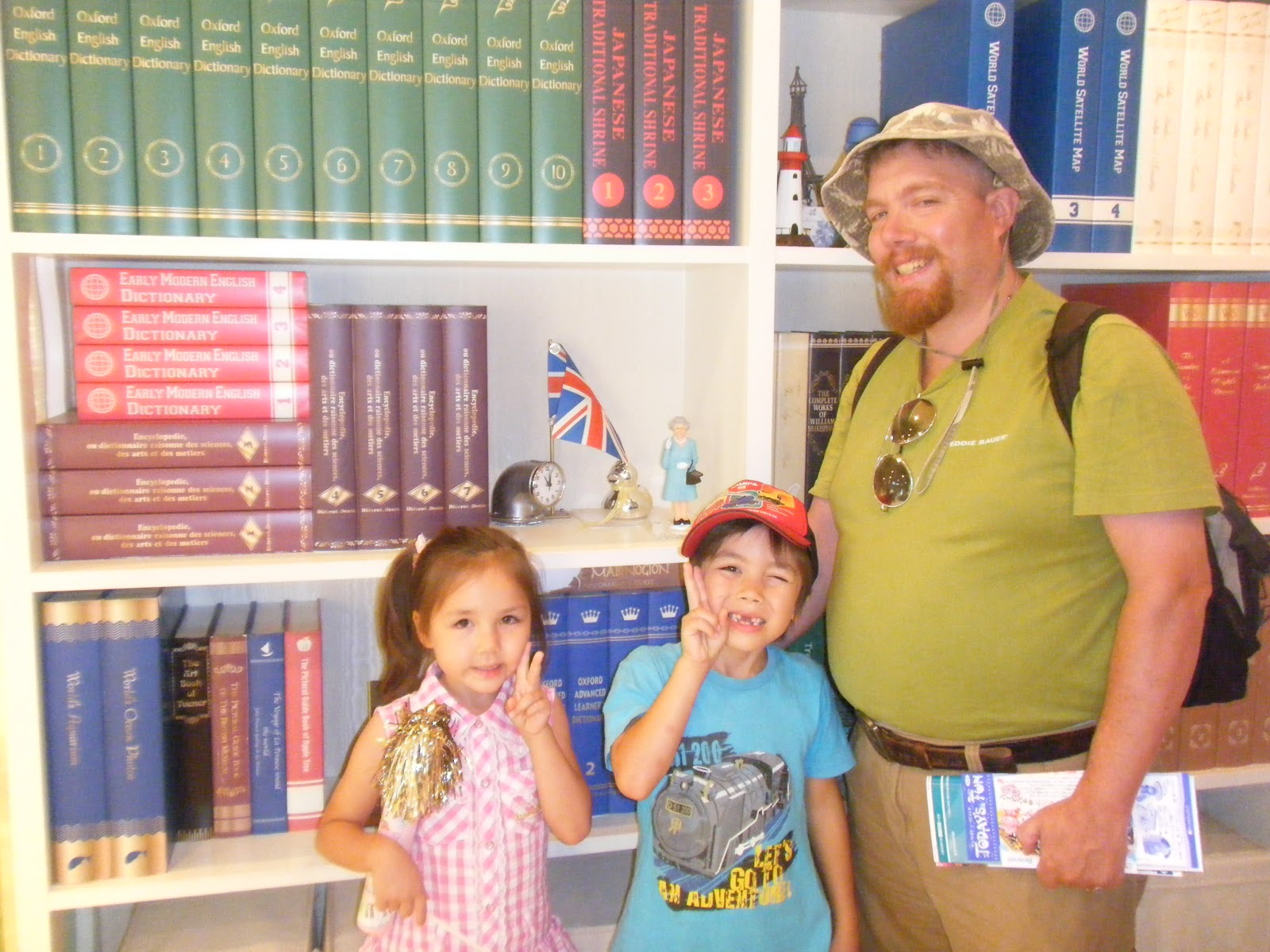
To commerate Queen Elizabeth II Diamond jublilee, they had this small corner on a book shelf devoted to her majesty. Since myself and my two children are Canadian citizens, we felt we should remember our soverign.
This was an interesting sight. A bear in the boys toilet. As you went in to do your business, you could hear this bear singing while on his "throne".
When you opened the door and said hello, he would then growl at you! Imagine some little boy who needed to wee wee and saw this in the toilet! Talk about giving a kid issues!
The shot below came in sideways but is Leena with a British Hello Kitty
Wednesday, 8 August 2012
Battle of Camden, August 16, 1780
As my summer vacation enters it's second week, I am hard at work studying but also enjoying some gamming. Today's action is part of the Southern Campaign.
The battle began with the Royal Artillery firing on the American centre and on the American artillery. After the initial volley of gunfire, the American line became disorganised. Amazingly, their militia stood their ground!
The second round of the battle began with the Americans advancing and exchanging musket volleys with the British line. The American skirmishers deployed to the American right to halt the advance of the Loyalist brigade. After a devestating volley on the 33rd Regt, the Americans gave a bayonet charge with momentarily caused the British line to fall back. The Light Dragoons were soon forced to deploy into the line to prevent a huge gap opening. On the British fourth turn, they then deployed and flanked the American left.
This move destroyed the American rifle units and caused half of the militia to become casualties. The American centre took a hard hit from the Royal Welsh. The Loyalists also hit the American right hard redeeming themselves in the eyes of the British commanders.
The British then hit the American left with a charge and fire from the Light Infantry.
The Americans then attempted to shift their line away from the pressure from the left towards the Loyalists on their right.
Eventually, the British pressure on the American line became too great, and they were forced to flee the field. Lord Rawdon was left in possession of the field and thus became victor, much like in history.
Please see japanesehighlander on youtube for a video clip of this battle.
Camden August 16, 1780
23rd, 33rd, 71st,
Volunteers of Ireland/105th, Tarelton's Legion, Loyalist militia
vs
1st Maryland, 2nd Maryland, Delaware
Regiment, North Carolina militia, Virginia Militia
The battle began with the Royal Artillery firing on the American centre and on the American artillery. After the initial volley of gunfire, the American line became disorganised. Amazingly, their militia stood their ground!
The second round of the battle began with the Americans advancing and exchanging musket volleys with the British line. The American skirmishers deployed to the American right to halt the advance of the Loyalist brigade. After a devestating volley on the 33rd Regt, the Americans gave a bayonet charge with momentarily caused the British line to fall back. The Light Dragoons were soon forced to deploy into the line to prevent a huge gap opening. On the British fourth turn, they then deployed and flanked the American left.
This move destroyed the American rifle units and caused half of the militia to become casualties. The American centre took a hard hit from the Royal Welsh. The Loyalists also hit the American right hard redeeming themselves in the eyes of the British commanders.
The British then hit the American left with a charge and fire from the Light Infantry.
The Americans then attempted to shift their line away from the pressure from the left towards the Loyalists on their right.
Eventually, the British pressure on the American line became too great, and they were forced to flee the field. Lord Rawdon was left in possession of the field and thus became victor, much like in history.
Please see japanesehighlander on youtube for a video clip of this battle.
Louisbourg 1758 Landing
(from Osprey British Light Infantryman of the Seven Year's War) This was the initial attack on the beachhead.Today's action was the amphibious assualt by the British on Kennington cove in June 1758 on the shores of Isle Royale to begin the siege of the Fortress of Louisbourg.
(Photos courtsey of Kerry DeLorey)
Chartrand (2000.49) writes that the British began landing troops beginning at 4am. The Royal Navy gave covering fire and the troops went ashore. However, it wasn't just a matter of rowing, the seas were rough and this was being done under fire. The French occupied prepared position which had been dug back in the summer of 1757. Their fire was enough to halt the landing. Wolfe who was in a boat was able to notice a very small cove which was not covered by the French. He then led the Left division which consisted of several Grenadier companies, light infantry, rangers, and 78th Highlanders. This force was able to flank the French lines which collapsed. This is now a video clip on my youtube channel japanesehighlander.Monday, 6 August 2012
Battle of Barossa 1811
The Battle of Barossa 5th
March, 1811
RA: Maj. Duncan 10 guns
Wheatley’s Bde: 28th
Foot, 67th Foot, 87th Foot
Dilkes’ Bde: 1st Foot
Guards, Composite Battn 2nd/3rd Foot Guards, 2coys 95th
Brown’s Light Battn: Light Companies of 9th,
28th, 82nd VS
French Army
1eme Bde Ruffin 2eme Bde Leval
9eme du Linge 8emeX 2
24eme X 2, 54eme X 2
96eme 45eme
Les Grenadiers 1 battn Les Grenadiers 1 battn
3eme Bde Artillery: 3 guns
The refight 8/6/12
This was made into a video clip
posted on youtube.
The battle began with
the French drawing cards first to begin. Leval’s brigade quickly established
themselves in the wood. The British began the game by advancing on Barrosa
ridge. The Light Infantry brigade hit first but were unable to stand up to the
French line’s volleys. The Royal Artillery was unable to make any headway
during the game. The French guns amazingly destroyed the RA and the French took
a gamble and charged a battery. They captured these guns. Wheatley's Brigade were
unable to regain the momentum despite clearing Leval’s brigade from the woods
but these were challenged by Ruffin sending in extra troops. As Dilke’s
attempted to hit Barrosa ridge, the French charged down. The British morale
collapsed and the line fled. The French won this battle.
Saturday, 4 August 2012
Katsuura Beach
Monday, 23 July 2012
Ian's Karate test
After four months, Ian was the only new student from his Dojo who was given the chance to try out for the next belt. All of the judges, parents, and other high level students felt he did a great job. For video clip please view youtube japanesehighlander Ian's Karate test
Still alive and kicking
Whoa! I just noticed that it's been nearly a month since I posted something here. Everytime I get the chance to try and put something up, I get distracted with family, work, etc.
This is what Leena wanted for her birthday. It's a Japanese girl hero costume. She enjoys dressing up and dancing like most little girls.
I have tried to upload video clips but have been unable to. My youtube channel of japanesehighlander does have some interesting clips of my activities.
These flyboys (and girls) are part of the Japanese Maritime Self-Defense Force Air units. Just on the edge of Kamagaya, Shiroi, Kashiwa, and Matsudo, is a large airbase. The base had an open house and I was able to take this one shot. When I went to enter, the guards asked me which country I was from, CANADA, so then they called their superiors and since CANADA is part of NATO they felt I was ok.
If I had answered Russian, I wonder what they would have said!
Subscribe to:
Posts (Atom)